Dark by Default: A Consent Firewall for Static Digital Collections
A two-repository architecture that keeps unreviewed material structurally absent from the public archive rather than merely hidden — the design behind the Bo Laurent Papers.
Working draft
Abstract
Metadata-driven static site generators — CollectionBuilder, Wax, and the broader Lib-Static and minimal-computing tradition — have made it possible for one person to publish a rigorous digital collection with no server, no database, and no institutional infrastructure. But they share a founding assumption: that everything described in the metadata is destined to be public. For institutional collections of already-cleared objects, that assumption holds. For personal papers, community archives, and oral history — corpora dominated by living third parties, private correspondence, and identifications that cannot be surfaced without review — it fails. In these collections the consent decision is not a preliminary step; it is the central and recurring editorial act.
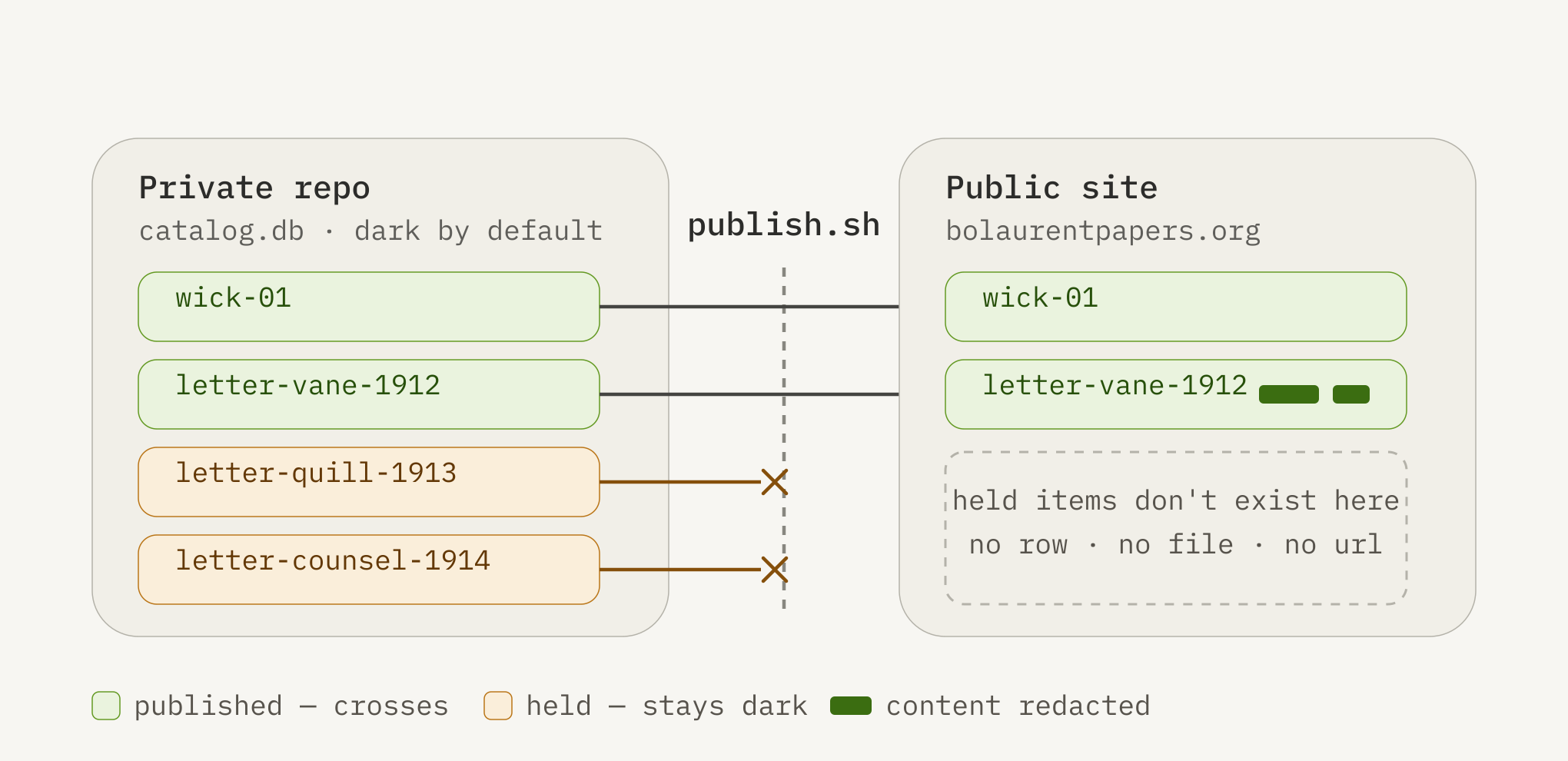
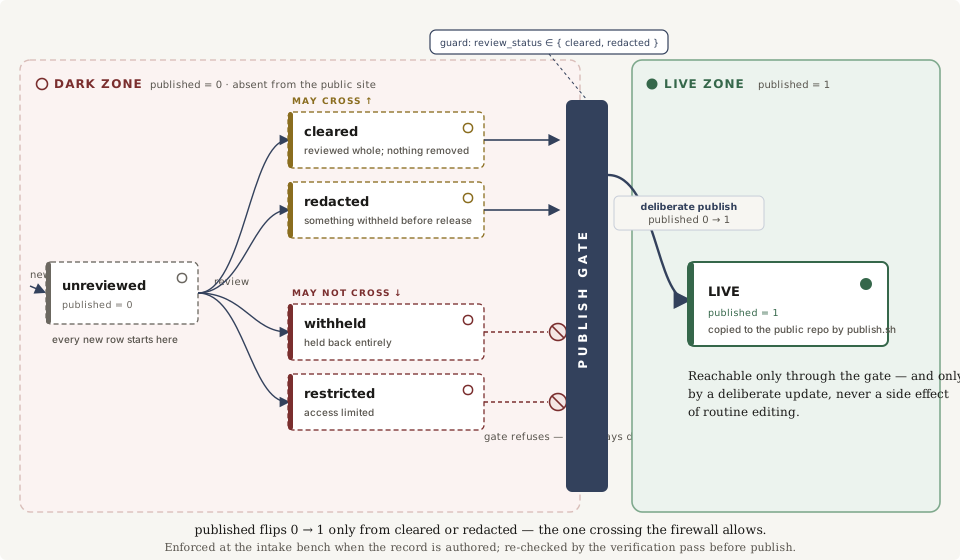
This article describes a consent firewall built onto a minimal-computing stack for The Bo Laurent Papers, an archive of the founding years of the intersex movement. The design makes non-publication the default and enforces it in the data layer rather than through editorial discipline. A relational catalog (SQLite) carries review status, a reviewer’s note, and a published flag as first-class fields; a two-repository architecture structurally separates a private working tier from the public site, so a dark item never enters the build at all; and a publish step copies only rows that have been explicitly cleared. Supporting patterns — an intake bench that surfaces the firewall’s state at the moment of description, reversible per-identification redaction, and provenance sidecars with fixity — carry the same principle through the workflow. The approach borrows the access-state logic of heavyweight repository frameworks such as Samvera and Islandora, but keeps it inside a stack that a non-technical steward can inherit, host at no cost, and eventually transfer to an institution intact.